
The Features your trying to use is on a network resource which is unavailable

Guys when you are  trying to install or Uninstall any software and your getting the below error which is preventing you from doing your work. Please follow the steps mentioned below and you can complete your task.

When your stuck on this error message please follow the below steps.

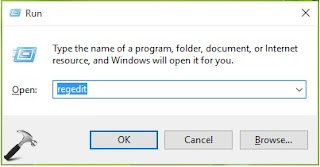
1. Press W8K + R and put regedit in Run dialog box to open Registry Editor (if you’re not familiar with Registry Editor, then click here). Click OK.

2. In the Registry Editor window, navigate to following registry key:
HKEY_LOCAL_MACHINE\SOFTWARE\Classes\Installer\Products
3. Expand Products registry key and you’ll see some long randomly named sub-keys. For each of these sub-keys, in the corresponding right pane, you can use ProductName registry string (REG_SZ) to identify to which program this sub-key belongs. Following that, you’ve to find the correct sub-key for the program with which you’re having issues. Once you spotted correct sub-key, right click on it and select Backup. Save the registry file with .reg extension, in case if is required in future. Then do a right click on same sub-key and select Delete. Click OK in confirmation prompt.

You can now close Registry Editor and re-try to install/uninstall program and issue should be resolved now.

Comments

Popular posts from this blog

  PowerShell DSC log amount issue on operating system drive Overview Problem Impact Microsoft Ticket (Workaround) solution References Overview When using PowerShell DSC on a configured system in some (seldom) cases it can lead to log amount issues in a specific folder. The following folder grows (over time) so several GB size holding hundreds and thousands of JSON log files as visible in the following screenshot: Also sometimes it looks like this: Problem The problem is (but must not be) related to DSC configuration issues as far as it could be analyzed. The log folder „Configuration Status“ is filled with sometimes up to 7 Megabyte sized JSON files. This log folder (based on our analysis) is used for sending reports to report server but is not cleaned up automatically. Impact Some PowerShell DSC managed systems need extensive disk space due to log directory grown to 40 Gigabyte plus. This causes an alert in disk space / availability monitoring and could in some cases lead to non w...

Vm backup failling with snapshot error (156)An error occurred while saving the snapshot: Failed to quiesce the virtual machine.

  Hi Everyone, I am here back with another issue. If anyone is getting error taking backup snapshot of a virtual machine and getting the below error. Vm backup failling with snapshot error (156)An error occurred while saving the snapshot: Failed to quiesce the virtual machine. Apr 28, 2021 2:22:55 AM - Critical bpbrm (pid=15849) from client XXXXX: FTL - vSphere_freeze: Snapshot task for virtual machine XXX-YYY (/vmmor/vm-341) failed, 0 retries remaining, error type: 263, error message: An error occurred while saving the snapshot: Failed to quiesce the virtual machine.. Apr 28, 2021 2:23:08 AM - Critical bpbrm (pid=15849) from client XXXX: FTL - vfm_freeze: method: VMware_v2, type: FIM, function:...

System Volume Information is taking more space

On one of the servers (running Windows Server 2012 R2) I faced a problem with the lack of free space on a system drive. I have cleared all resource-consuming locations ( WinSxS , TEMP directories, user profiles,  outdated updates , etc.), but it didn’t have any evident effect. At last, I have found that a large part of a system disk has been occupied by  System Volume Information  folder. Let’s consider why we need System Volume Information folder in Windows systems, what is stored in it and how to clean up it. Note . The instructions given in this article are applicable to other Windows versions as well:   Windows 10, Windows 7, Windows 8, Windows 2008 R2, Windows 2012 / 2012 R2. System Volume Information  folder is in the root of each disk. System data related to system recovery and Shadow Copy Service are stored in it. By default it is hidden and only the SYSTEM has access to it. Even the administrator cannot open it and look through the contents of th...